
How RGB drone imagery and Agremo Plant Vigor Analysis help farmers identify irrigation issues early, before yield losses become irreversible.
Every growing season, farmers invest heavily in seed, fertilizer, crop protection, and irrigation to maximize yield potential. Yet even the best irrigation system is only as effective as its weakest sprinkler. A single clogged nozzle, pressure imbalance, or malfunctioning span on a center pivot can silently reduce crop performance for weeks before anyone notices. By the time symptoms become visible from the ground, the damage has often already been done. This is exactly why more growers are turning to drone-based crop monitoring. Using nothing more than an RGB drone and Agremo’s AI-powered Plant Vigor Analysis, farmers can detect irrigation issues while there’s still time to fix them and protect thousands of euros in potential revenue.
Why Pivot Irrigation Performance Matters
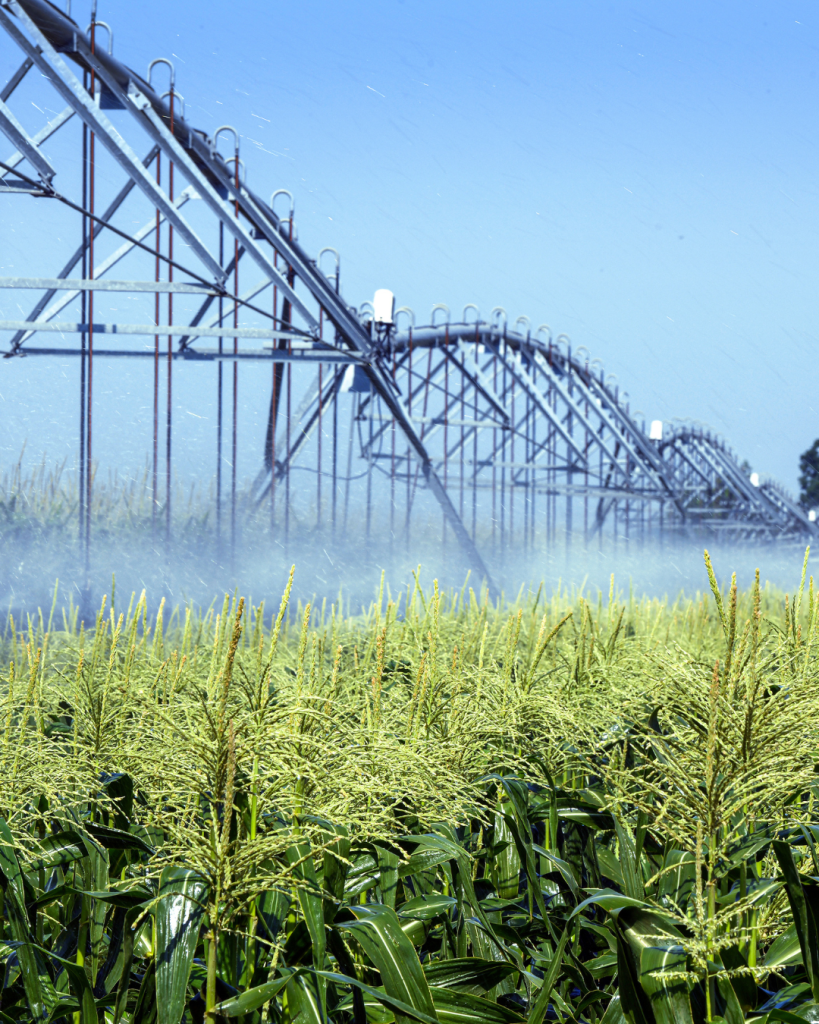
Center pivot irrigation is one of the most efficient irrigation systems in modern agriculture. It allows farmers to irrigate large fields uniformly while optimizing water use and improving crop consistency. According to the Food and Agriculture Organization (FAO), although only around 20% of the world’s cultivated land is irrigated, it produces approximately 40% of global food production. Research also shows that irrigation can increase crop yields by 50–200% compared to rainfed production, depending on crop type and local conditions. But these benefits depend on one critical assumption: The irrigation system must operate perfectly. When a few sprinklers stop working or water distribution becomes uneven, crops begin experiencing water stress long before it is obvious to the human eye. The result is reduced plant vigor, uneven development, and ultimately significant yield losses.
The Traditional Way: Walking the Field
Before using Agremo, irrigation monitoring relied almost entirely on field inspections. The farm team regularly walked around the pivot, visually checking:
- Whether sprinklers were working
- Whether every span was irrigating correctly
- Whether obvious leaks or mechanical failures were present
While experienced operators could identify some issues, the process had important limitations. Management had almost no visibility into irrigation quality. Most problems remained known only to field personnel, while their true impact became visible only during harvest or after yield mapping was completed. By then, it was simply too late.
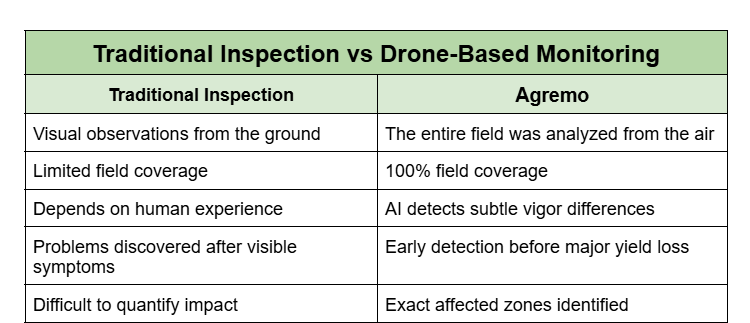
The biggest advantage isn’t saving inspection time. It’s gaining actionable accuracy. Instead of wondering whether irrigation is working properly, growers know exactly where problems exist and can fix them before yield potential is permanently lost.
How Easy Is It with Agremo?
One of the biggest misconceptions is that irrigation monitoring requires expensive multispectral sensors. It doesn’t. A standard RGB drone is enough.
Step 1. Fly the Field
Map your field using any RGB drone. There is no need for ultra-high resolution imagery. Even flight missions above 3 cm/pixel provide more than enough detail for irrigation diagnostics. Because of the higher flight altitude, growers can map an entire field in just a few minutes.
Step 2. Upload Images to Agremo
Upload raw images to Agremo. Simply request Plant Vigor Analysis. No additional calibration or complex workflow is required.
Step 3. Let AI Find the Problem
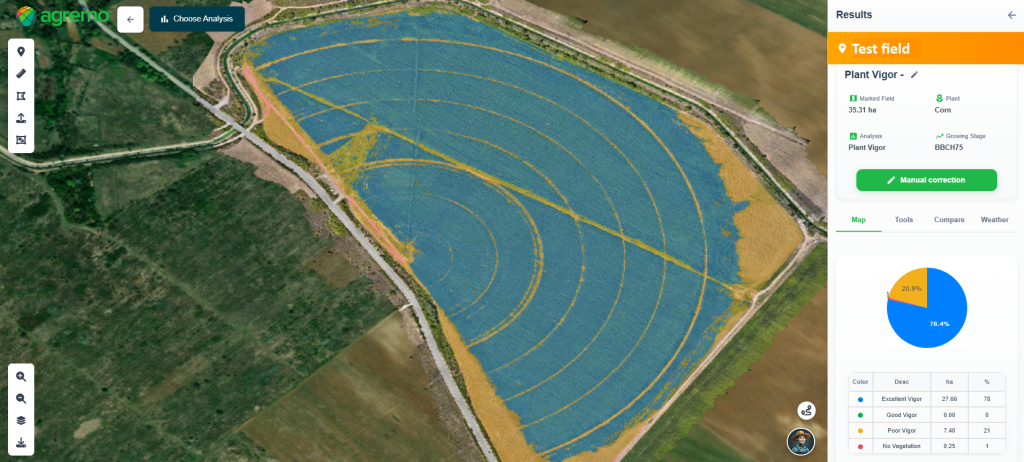
Agremo analyzes the entire field and automatically identifies zones where plants exhibit reduced vigor. In many cases, these low-vigor patterns form distinctive arcs or sections following the pivot’s irrigation path.
These patterns often reveal:
- Clogged nozzles
- Broken sprinklers
- Pressure inconsistencies
- Water distribution problems
- Sections receiving insufficient irrigation
Instead of inspecting hundreds of sprinklers manually, farmers immediately know where to investigate.
Real Customer Results
Our customer used Agremo to evaluate pivot performance on 15–20 hectare corn fields. The analysis revealed something surprising. Approximately 20% of the irrigated area was receiving insufficient water.
Those zones eventually produced only 7.5–8 tons per hectare, while properly irrigated areas yielded 15–16 tons per hectare. That represents nearly a 50% yield reduction in the affected parts of the field.
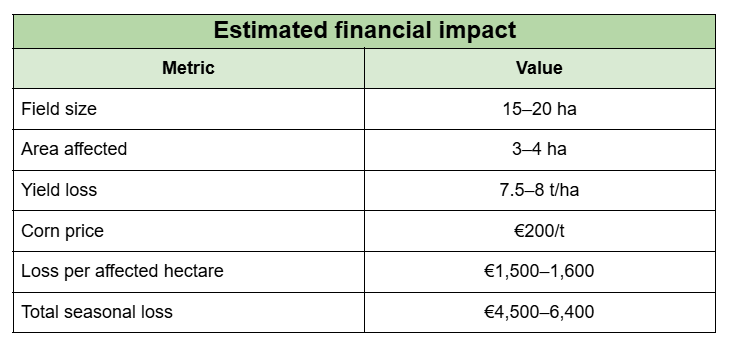
Without drone monitoring, these issues would likely have remained unnoticed until harvest. With Agremo, the irrigation problem was detected early enough for corrective action, minimizing yield losses.
Customer Testimonial
“Agremo allowed us to see problems that were practically invisible from the ground. What used to be guesswork became a precise, data-driven process. In just a few minutes, we can map an entire pivot and identify irrigation issues before they translate into major yield losses. The return on investment was immediate, preventing even a small percentage of yield loss, which pays for the analysis many times over. Today, Agremo is one of our most valuable tools for protecting crop performance and maximizing profitability.”
Vladimir Nikolov, Digital Transformation Manager, Kristera Agro