Every growing season, growers and researchers face the same critical question:
When is a crop truly ready for harvest?
The answer is rarely straightforward. Crop maturity often varies across a field due to differences in soil conditions, water availability, hybrid characteristics, and environmental factors. While one area may be ready for harvest, another may still be actively maturing, making it difficult to determine the optimal harvest window based on visual inspection alone.
For commercial growers, harvesting too early can result in higher seed moisture, increased drying costs, and reduced storage quality. Waiting too long, however, increases the risk of lodging, bird damage, weather-related losses, and seed shattering.
For seed companies, the challenge is different but equally important. Breeders and researchers need to understand how quickly each hybrid progresses toward maturity. Every hybrid is developed with an expected maturity profile – for example, 90-, 100-, or 110-day maturity – but environmental conditions can significantly influence how quickly that hybrid reaches harvest readiness. Breeders need objective data to verify whether each hybrid performs according to its specification under real field conditions.
In sunflower breeding programs, researchers may evaluate more than 70 agronomic characteristics throughout the season, including emergence, vigor, flowering, disease resistance, plant architecture, maturity, and stay-green performance. Collecting this information manually across hundreds of plots is labor-intensive, time-consuming, and inherently subjective.
Whether the goal is planning harvest operations or evaluating hybrid performance, objective measurements of crop maturity are essential.
WHY STAY GREEN MATTERS
Production Fields: Harvest at the Right Time
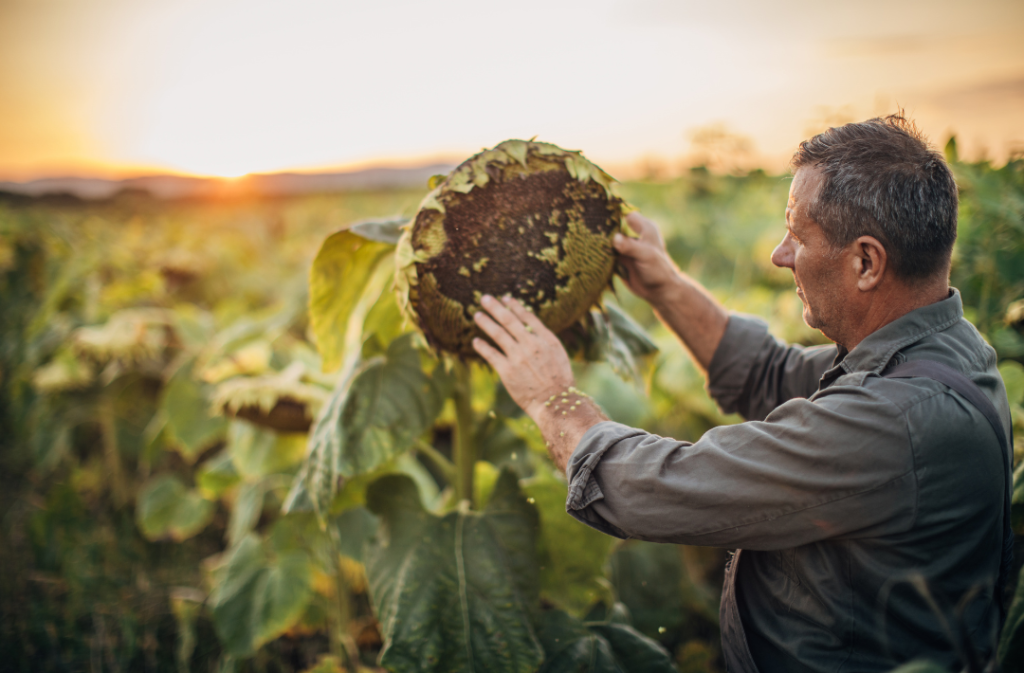
This was exactly the challenge Bill faced while managing a 95-hectare sunflower field. As harvest approached, most of the field appeared ready. However, Bill knew from experience that sunflower maturity is rarely uniform. Variations in soil conditions, moisture availability, and plant development meant that while some areas had already reached harvest maturity, others remained noticeably greener.
In fact, if just 15% of the field was still actively maturing, that represented more than 14 hectares where harvesting too early could increase drying requirements. Waiting for those areas to mature, on the other hand, would leave the remaining 80 hectares exposed to additional weather, bird damage, and harvest losses. Walking the field wasn’t enough. On nearly 100 hectares, scouting only a handful of locations couldn’t accurately represent the maturity of every part of the crop. Bill needed a way to see exactly where the crop was still green and where it was ready for harvest. Using Agremo’s Canopy Cover Analysis, Bill uploaded drone imagery of the field and received a detailed maturity map showing the distribution of green canopy across the entire field. Instead of relying on assumptions, he could objectively identify areas that were still actively maturing and make a more informed harvest decision.
Sunflowers are typically harvested at 18–20% seed moisture before being dried to approximately 9–12% moisture for safe storage. By understanding maturity variability across the field, Bill could better determine the optimal harvest window and avoid harvesting areas that still required additional dry-down. The result was greater confidence in harvest timing, reduced uncertainty, and better planning for one of the most critical operations of the season.
Monitoring stay-green characteristics allows growers to understand how uniformly the crop is maturing and identify areas that are progressing more slowly toward harvest.
Better visibility into crop maturity helps producers:
- Determine the optimal harvest window,
- Reduce unnecessary drying costs,
- Minimize exposure to late-season weather risks,
- Improve harvest planning and logistics.
Field Trials: Evaluating Hybrid Maturity
For breeding companies and research organizations, the objective is different. Rather than deciding when to harvest, researchers need to determine how long each hybrid requires to reach harvest maturity.
Each hybrid has an expected maturity specification, but performance varies across environments. Understanding whether a hybrid matures according to its expected development is critical when selecting new genetics for commercial release.
With the help of Stay-Green Analysis, researchers monitor it because it reflects how long plants maintain green leaf area before senescence. Traditional evaluation relies heavily on visual scoring, making it difficult to compare dozens or even hundreds of trial plots consistently.
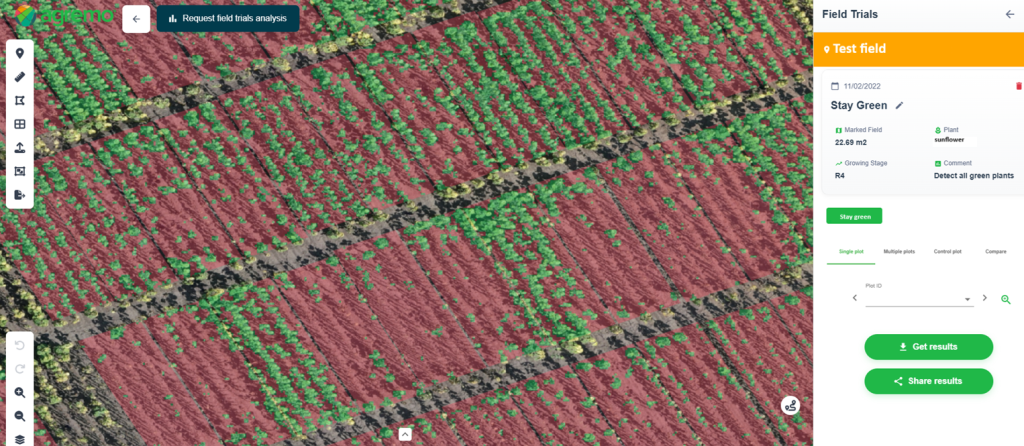
Agremo’s Stay Green Analysis provides objective measurements of canopy greenness for every plot throughout the growing season, allowing researchers to:
- Compare maturity progression between hybrids
- Quantify senescence instead of estimating it visually
- Verify whether hybrids meet their expected maturity profile
- Identify hybrids that mature earlier or later
- Generate standardized, repeatable data across every trial
This provides breeders with more reliable information while significantly reducing manual evaluation effort.
WHY IT IS EASY WITH AGREMO
Whether you’re managing a commercial production field or conducting field trials, generating maturity insights with Agremo requires just a few simple steps.
Step 1 – Fly the Field
Capture high-resolution drone imagery of the sunflower field during the late stages of the growing season, when maturity differences begin to appear.
Step 2 – Upload Imagery to Agremo
Upload the stitched orthomosaic to the Agremo platform. Once the imagery is processed, simply select the analysis that matches your use case.
Step 3 – Request the Analysis
Agremo offers two different analyses depending on your objective:
- For Production Fields –> Request Canopy Cover Analysis to identify areas that remain green and estimate harvest readiness across the field. The analysis helps growers understand maturity variability and determine the optimal harvest window.
- For Field Trials –> Request Stay Green Analysis to objectively compare canopy greenness between trial plots, evaluate maturity progression, and verify whether individual hybrids perform according to their expected maturity specifications.
Step 4 – View Results
Agremo automatically generates detailed maps and reports that visualize crop maturity across the entire field or every trial plot.
- For production fields, growers receive a spatial overview of harvest readiness, helping them plan harvest operations with greater confidence.
- For field trials, researchers receive objective, plot-level measurements that simplify hybrid comparison and support more consistent breeding decisions.
ECONOMIC IMPACT
For Bill, the greatest benefit wasn’t simply having another map – it was having confidence in one of the most important decisions of the season.
“Before using the analysis, we relied on field walks and experience. The maturity map gave us a complete overview of the field and helped us understand exactly where the crop was still green and where it was ready for harvest.”
Instead of making a harvest decision based on a handful of scouting locations, Bill could evaluate maturity across the entire 95-hectare field and plan harvest with much greater confidence.
1. Reduced Drying Costs
Harvest timing has a direct impact on post-harvest costs. Sunflower is typically harvested at 18–20% seed moisture before being dried to approximately 9–12% moisture for safe storage. Every additional percentage point of moisture removed requires additional drying time and energy.
“Knowing which areas were ready gave us much more confidence in scheduling harvest. Rather than relying on estimates, we could make decisions based on actual field conditions.”
By identifying areas that remained actively green, Bill could avoid harvesting immature portions of the field before they reached the desired maturity.
2. Lower Harvest Losses
Waiting too long can be just as costly as harvesting too early. As sunflower remains in the field after maturity, the crop becomes increasingly vulnerable to lodging, bird damage, adverse weather, and head shattering. Extension studies estimate that losing just 10 sunflower seeds per square foot corresponds to approximately 112 kg/ha of yield loss.
“Instead of delaying harvest for the entire field, we finally understood how maturity varied across different parts of the field.”
Having a spatial view of maturity helped Bill balance the trade-off between harvesting too early and waiting too long.
3. Better Hybrid Selection
For breeding programs, objective maturity data reduces reliance on subjective visual scoring and enables more confident comparisons between hybrids. Instead of relying solely on field observations, researchers obtain quantitative measurements that help verify maturity specifications, identify superior genetics, and support more informed breeding decisions.
CONCLUSION
Whether you’re managing a commercial sunflower field or evaluating hundreds of breeding plots, understanding crop maturity is essential for making informed decisions.
With AI-powered analysis of drone imagery, Agremo transforms visual field data into objective maturity insights. Instead of relying solely on field scouting, growers and researchers receive accurate, field-wide information that supports faster, more confident decision-making.
For growers, Agremo helps determine when a field is ready for harvest by identifying maturity variability and highlighting greener areas that may require additional time before harvesting.
For researchers, Agremo provides objective, plot-level measurements that make it easier to compare hybrids, monitor maturity progression, and evaluate whether each hybrid performs according to its expected maturity profile.
Whether the goal is maximizing harvest efficiency or improving breeding decisions, Agremo delivers the data needed to make informed decisions throughout the crop lifecycle.