
Early-season establishment is critical for achieving high canola yields. However, pest damage shortly after emergence can quickly turn a promising crop into an uneven field with large differences in plant development.
This was exactly the situation faced by Technifarm. After severe snail damage destroyed much of the original crop, the grower replanted the field. Once the new plants emerged, the challenge was identifying where the crop required additional fertilizer and snail pellets.
>Instead of applying products uniformly across the entire field, the grower used Agremo Plant Vigor Analysis to create variable-rate prescription maps, reducing unnecessary applications while ensuring vulnerable areas received the protection they required.

Why This Matters
Snails are among the most damaging pests during the early growth stages of canola. They feed on emerging seedlings, reducing plant populations and creating patches where little or no crop survives.
When severe damage forces replanting, growers face significantly higher production costs from additional seed, labor, and uneven crop establishment across the field. Some areas recover with healthy, vigorous plants, while others remain weak or completely bare. Applying fertilizer and crop protection products at uniform rates under these conditions often leads to wasted inputs in non-productive areas and unnecessary treatments where crops no longer require intervention.
Without accurate information, growers typically continue using uniform application rates across the entire field. This creates several challenges:
- Fertilizer is wasted in areas with no surviving plants.
- Healthy parts of the field may receive unnecessary snail treatments.
- Inputs are applied where they provide little or no return.
- Production costs increase while crop recovery remains inconsistent.
Making the right decision requires understanding exactly where plants are thriving, where they remain vulnerable, and where no crop exists at all.
The Agremo Approach
To accurately assess crop establishment after replanting, the customer flew the field using a DJI Mavic 3 Multispectral (Mavic 3M) drone. Unlike satellite imagery, drone flights could still be performed despite the cloudy and foggy winter conditions, providing timely data when application decisions needed to be made.
Stitching and Plant Vigor Analysis
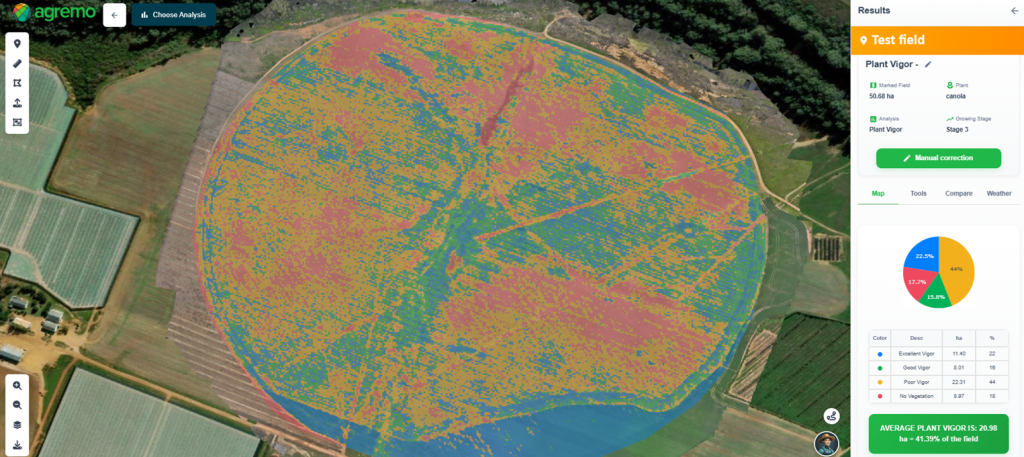
The imagery was processed in Agremo and Plant Vigor Analysis has been requested, which classified the field according to crop vigor and clearly distinguished:
- Areas with no surviving plants
- Areas with weak or newly established plants
- Healthy, vigorous canola
Using these insights, Agremo created spatial management zones that the customer converted into prescription maps for variable-rate application.
Creating Prescription Maps
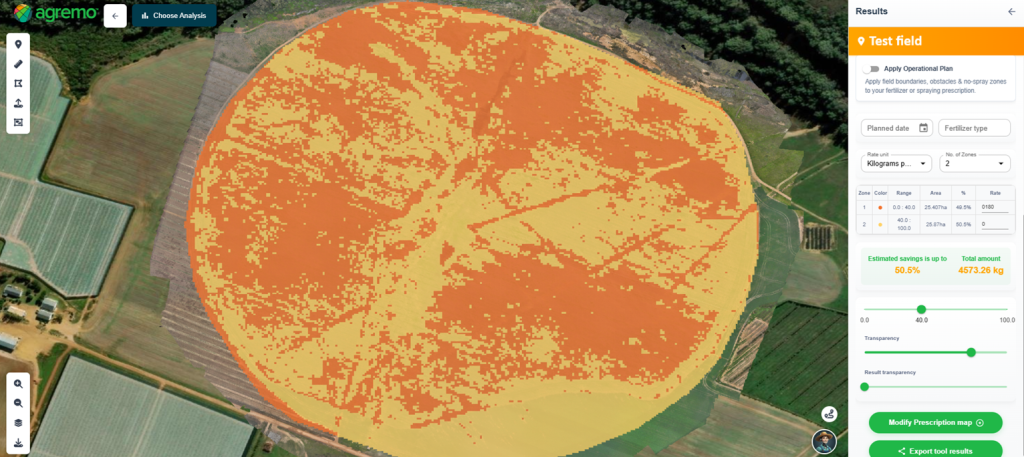
Based on the Plant Vigor Analysis, two prescription maps were created.
FERTILIZER PRESCRIPTION
The field was divided into two management zones:
- 0 kg/ha in areas where no plants remained
- 180 kg/ha in productive areas
This ensured fertilizer was only applied where it could contribute to crop growth.
SNAIL PELLET PRESCRIPTION
A second prescription map created three application zones:
- 10 kg/ha where no plants remained and snail pressure was highest
- 8 kg/ha where young plants were still vulnerable
- 0 kg/ha where healthy plants no longer required treatment
The customer exported prescription maps from Agremo and used them with existing application equipment to apply products precisely where needed instead of using a single rate across the entire field. Fertilizer application was performed using a John Deere + Amazone spreaders, while DJI T100 was used for the targeted application of snail pellets.
Customer Results
Using Agremo’s Plant Vigor Analysis and Spot-spraying and variable-rate prescription maps, the customer transformed a field with highly uneven crop establishment into a targeted management operation.
Reduced fertilizer use
By using Agremo’s Plant Vigor Analysis, the customer reduced the average fertilizer application rate from 180 kg/ha to 145.95 kg/ha, saving approximately 1.43 tonnes of fertilizer across the 50.68-hectare field—a total reduction of 18.9%.
>While these results were achieved on a 50.68-hectare canola field, they illustrate the significant impact precision fertilizer application can have on larger farming operations. Assuming similar crop variability and management practices, the same 18.9% reduction in fertilizer use could generate substantial savings across a 5,000-hectare farm. Beyond reducing input costs, variable-rate application helps eliminate unnecessary fertilizer use in non-productive areas, improving input efficiency and ensuring every kilogram applied contributes to crop performance.
More efficient snail control
Rather than applying snail pellets uniformly across the field, the customer targeted treatments only in areas that remained vulnerable after replanting. Healthy areas received no additional application, reducing unnecessary product use.
Agremo generated a three-zone prescription:
– 10 kg/ha where no plants remained
– 8 kg/ha where plants were still vulnerable
– 0 kg/ha where plants had already established
This reduced unnecessary product use while ensuring the highest-risk areas received additional protection.
More efficient field operations
By using Agremo’s prescription maps, the customer significantly improved the efficiency of field operations after replanting. Compared to a uniform application strategy, the customer used 1.43 tonnes less fertilizer across the 50.68-hectare field. Agremo prescription maps helped avoid fertilizer use in non-productive zones and reduced unnecessary applications. At the same time, the customer applied snail pellets only where crop establishment and pest pressure justified treatment. This targeted approach reduced input waste, improved operational efficiency, and ensured every application delivered greater agronomic value.
Better decisions through accurate field data
Instead of relying only on visual scouting, the customer used Agremo Plant Vigor data to identify areas requiring intervention. This data-driven approach improved application decisions and helped direct inputs where they delivered the greatest agronomic value.
Reliable data despite poor satellite conditions
Winter cloud cover and fog limited satellite imagery, but the Mavic 3 Multispectral drone still captured high-quality data, enabling the customer to make timely management decisions without delay.
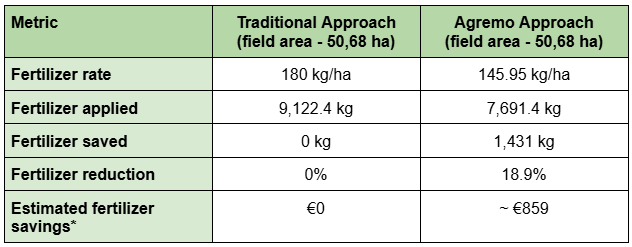
*Estimated using an average fertilizer price of €0.60/kg. Actual savings will vary depending on fertilizer type and local market prices
Customer quote
“The biggest advantage was knowing exactly where the crop needed attention. Agremo helped us turn an uneven replanting situation into a targeted management strategy.”
Luks Odendaal, TechniFarm