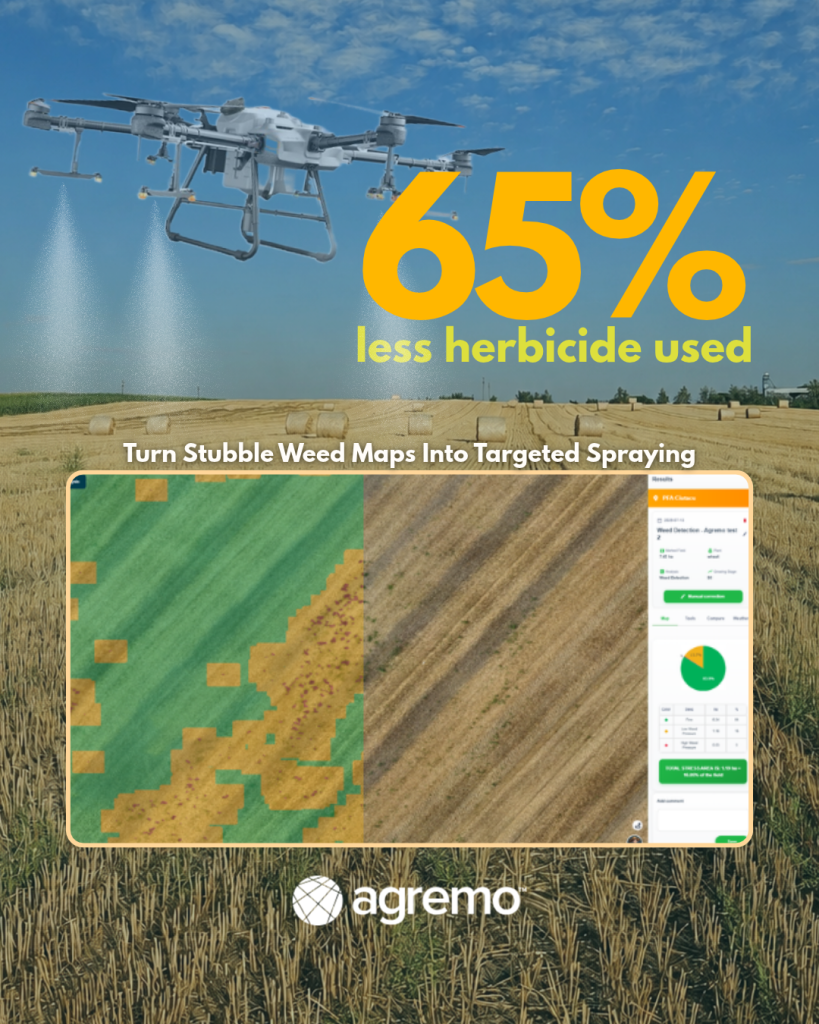
Spot spraying: A smarter approach to weed control
Every growing season, farmers invest thousands of euros in herbicides to protect crop yields. But when weeds are concentrated in only a fraction of a field, blanket spraying often means treating far more area than necessary. This is where spot spraying is changing modern precision agriculture. Instead of treating every hectare equally, spot spraying combines drone imagery, AI weed detection, and prescription maps to identify exactly where weeds are located. The result is targeted precision spraying that applies herbicide only where it is needed, helping growers reduce chemical use while maintaining effective weed control. As more farms adopt drone crop scouting and precision farming technologies, spot spraying is becoming an increasingly practical way to lower input costs, improve sustainability, and make better management decisions based on real field conditions rather than assumptions.
Why spot spraying matters
Herbicides represent one of the highest variable costs in crop production. Every unnecessary liter sprayed translates directly into higher production costs, additional water use, more machine hours, and unnecessary environmental impact. The challenge is that weed infestations are rarely uniform. In most fields, weeds develop in patches. However, traditional spraying methods often treat the entire field because accurately locating those patches through manual crop scouting is time-consuming and difficult. This becomes even more challenging in green-on-green weed detection scenarios, where both the crop and the weeds are actively growing and appear similar in color.
In this particular case, a wheat grower needed to control self-seeded sunflowers within a wheat field. Because both plants were green and the infestation was scattered throughout the field, identifying affected areas using traditional scouting methods alone would have required significant time and still carried the risk of missing problem areas. Rather than spraying the entire field, the grower wanted a way to identify weed-infested zones and apply herbicide only where necessary, precisely.
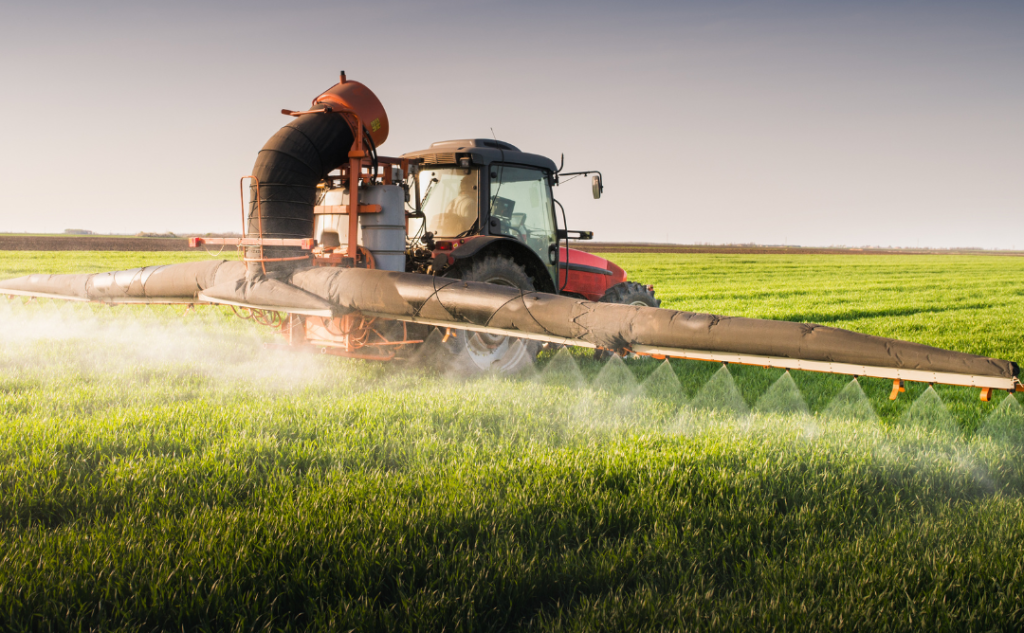
Traditional scouting vs. Agremo AI-powered weed detection
Traditional approach
For decades, growers have relied on field scouting, visual inspection, and experience to determine whether herbicide applications are needed.
While experienced agronomists can identify weed pressure, manual scouting has several limitations:
- It only covers a small percentage of the field.
- Weed patches between scouting locations may go unnoticed.
- Large fields require significant labor and time.
- To avoid missing weeds, growers often resort to blanket applications.
Although effective, this approach can increase herbicide costs, water consumption, fuel usage, and machine hours.
The Agremo approach
Agremo transforms this workflow using drone weed mapping and AI. After a drone flight captures high-resolution aerial imagery, growers simply upload the orthomosaic into the Agremo platform. Agremo’s AI automatically analyzes the imagery, detects weed-infested areas, and distinguishes weeds from crops – even in challenging green-on-green conditions. The platform then generates detailed weed maps and prescription maps that can be exported for variable-rate application (VRA) or spot spraying.
Instead of wondering whether the entire field should be sprayed, farmers can make a much more informed decision:
“Which specific parts of my field actually require treatment?”
This allows farmers to reduce herbicide use without compromising weed control, while improving operational efficiency and supporting more sustainable crop production.
Why is it easy with Agremo:
With Agremo, you can generate a spot spraying prescription map in just a few steps
Step 1. Fly the field –> Capture high-resolution drone imagery during the growing season.
Step 2. Upload imagery to Agremo –> Upload the stitched orthomosaic or raw images to the Agremo platform.
Step 3. AI Weed Detection –> Agremo performs green-on-green weed detection, identifying self-seeded sunflower growing within the wheat crop and mapping weed distribution across the field.
Step 4. Generate Prescription Maps –> Based on detected weeds, Agremo automatically creates prescription maps for variable-rate application (VRA) and precision spraying.
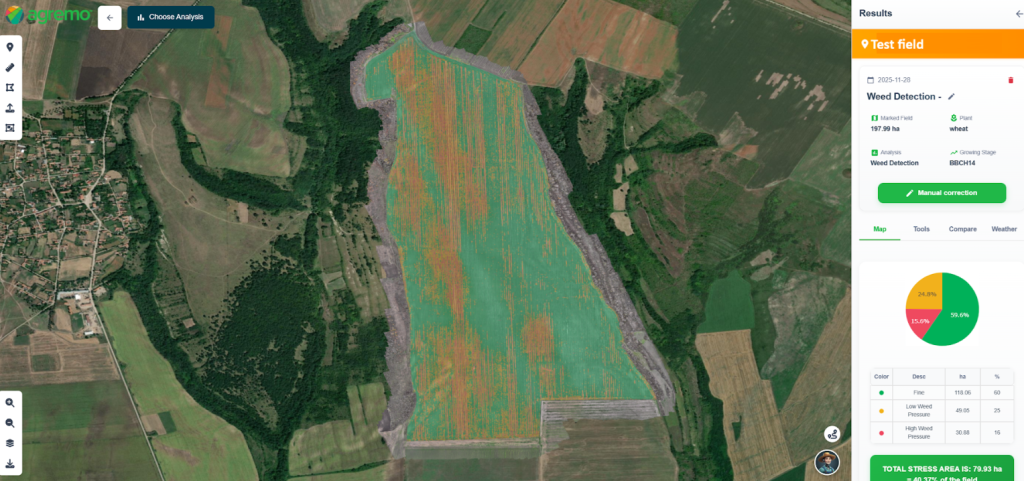
Real-World Results from Precision Agriculture
To test Agremo’s AI-powered weed detection and spot spraying, a wheat grower used a John Deere R4030 (Model Year 2015) equipped with section control, but without nozzle-by-nozzle control. This demonstrates that growers don’t need the latest machinery to benefit from precision spraying.
After analyzing drone imagery, Agremo detected self-seeded sunflowers within the wheat crop and generated a prescription map for targeted application.
The results included:
- 61.5% reduction in herbicide use (6.15 kg of Flame Duo saved)
- Approximately €650 saved on herbicide
- More than 18,000 liters of water saved
- Application completed in a single afternoon instead of nearly a full day, allowing the grower to finish before incoming rain.
This case shows how drone imagery, AI weed detection, and prescription maps can help growers reduce input costs, improve operational efficiency, and implement spot spraying using equipment they already own.
By treating only weed-infested areas, the grower saved more than 18,000 liters of water in a single application. Beyond reducing water consumption, fewer tank refills also meant less downtime and faster field operations.
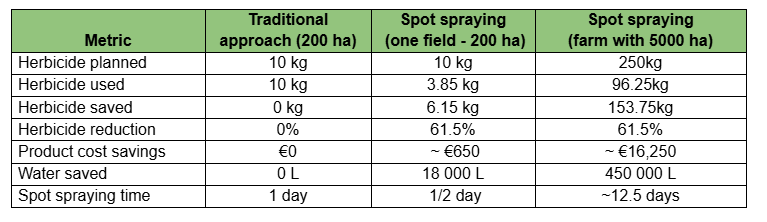
While these results were achieved on a 200-hectare wheat field, they illustrate the potential impact of AI-powered spot spraying on larger farming operations. If similar field conditions and weed pressure were present on a 5,000-hectare farm, the potential savings could exceed €16,250 in herbicide costs, 450,000 liters of water, and approximately 154 kg of herbicide in a single spraying pass. Beyond the financial savings, fewer tank refills and shorter spraying windows allow operators to cover more ground in less time, helping them complete applications before weather conditions change. Actual savings will vary depending on weed pressure, field variability, and spraying strategy.
Beyond measurable savings, the grower also highlighted the operational benefits of spot spraying:
“Normally I am spraying this almost 200 ha field in one day with the logistics of filling – but with this Spot map we managed in one afternoon.”
Vladimir Nikolov, Digital Transformation Manager, Kristera Agro
With AI-powered weed detection, drone weed mapping, prescription maps, and variable-rate application (VRA)/spot spraying, Agremo helps growers transform conventional spraying into precision spraying.
This case demonstrates that precision spraying doesn’t require the newest machinery – only better data. By combining drone imagery, AI weed detection, and prescription maps, growers can reduce herbicide use, lower operating costs, conserve water, and complete spraying more efficiently. Whether managing 200 hectares or several thousand, spot spraying enables farmers to make more informed, data-driven decisions while maximizing the return on every application.