How AI Weed Detection Helped a Wheat Farm Target Broadleaf Weeds and Reduce Herbicide Costs by 72%
Broadleaf weeds are more than just a visual problem in a wheat field. When they emerge and grow alongside the crop, they compete with wheat for water, nutrients, sunlight, and growing space. Heavy weed pressure can reduce crop performance. Tall and dense weeds can also make wheat harvesting more difficult. For wheat growers, identifying where broadleaf weeds are concentrated is therefore critical. A blanket herbicide application across the entire field can be costly, especially when weed pressure is uneven.
In this case, AI-powered weed detection was used to identify broadleaf weed hotspots in a mid-season wheat field and guide a targeted herbicide application. The result was a 72% reduction in herbicide costs across 198.2 acres.
The Challenge: Broadleaf Weeds Threatening Wheat Production and Harvest
Broadleaf weeds can have a significant impact on wheat production. They compete with wheat for water, nutrients, light, and growing space, while heavy infestations can also interfere with harvest operations. According to the University of Nebraska–Lincoln, annual broadleaf weeds are estimated to reduce winter wheat yields in Nebraska by 10% every year.
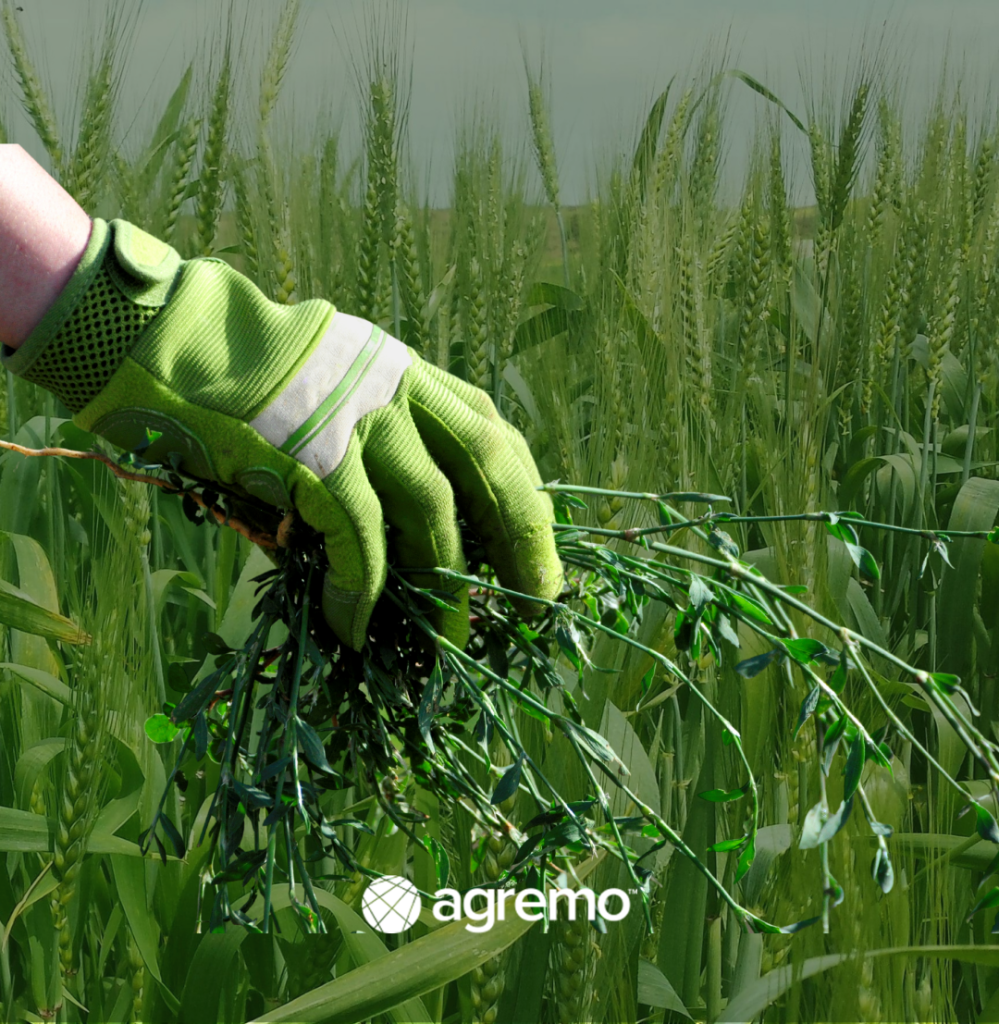
The field had a significant broadleaf weed problem during the middle of the growing season. These weeds had survived the initial herbicide applications and continued growing until some were taller than the wheat. In certain areas, weed density was so high that harvesting entire sections of the field would have been difficult or potentially impossible. This type of weed pressure creates two problems.
First, dense broadleaf weeds compete directly with wheat for essential resources such as water, nutrients, and sunlight. If left unmanaged, this competition can negatively affect crop development and yield potential.
Second, when weeds become large and dense enough, they can interfere with harvesting operations and make already difficult field conditions even more challenging.
The farm therefore needed to answer a simple but important question:
Where are the weeds, and where is additional herbicide actually needed?
Case Study at a Glance
- Farm: Klein Family Farms, Stockton, CA.
- Drone Service Provider: Pacific Fieldworks
- Crop: Wheat
- Field size: 80.2 ha / 198.2 acres
- Growth stage: Mid-season
- Target weeds: Broadleaf weeds
- Herbicide cost: $30/acre
- Application drone: DJI Agras T100
The Solution: AI Detection of Broadleaf Weeds
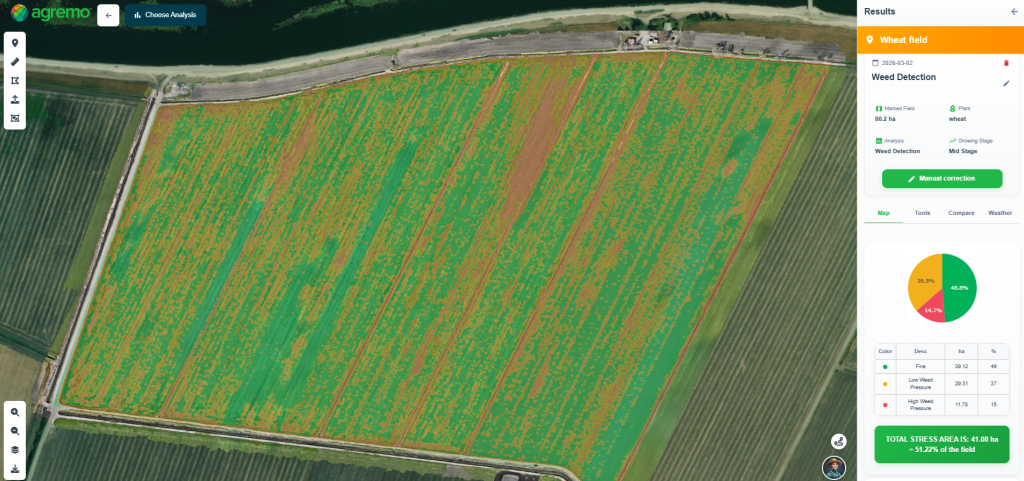
Instead of treating the entire wheat field uniformly, the farm used Agremo’s AI Weed Detection to map the distribution of broadleaf weeds and identify areas for targeted treatment. The analysis detected broadleaf weeds across 51.22% of the field, revealing significant weed pressure and helping the grower determine where additional herbicide application was needed.
01 — Map the Field
The grower mapped the wheat field using a drone at 1.5 cm/pixel resolution to capture high-detail imagery.
02 — Upload Raw Images
The raw drone images were uploaded directly to Agremo for processing.
03 — Automatic Stitching
Agremo automatically stitched the images into a complete, high-resolution field map.
04 — Get Initial Field Insights
In less than an hour, the stitched map was available in Agremo, along with automatically generated vegetation index results (NDVI)
05 — Detect What Vegetation Indices Can’t
Because vegetation indices cannot reliably distinguish weeds from wheat in green-on-green conditions, the grower requested an AI Weed Detection analysis.
06 — AI Identifies Broadleaf Weeds
Within just a few hours, Agremo delivered the AI analysis, accurately identifying and mapping broadleaf weeds across 51.22% of the field.
07 — Turn Detection Into Action
The weed detection map provided the grower with actionable data to target herbicide application only where additional treatment was needed.
The Result: 72% Lower Herbicide Costs
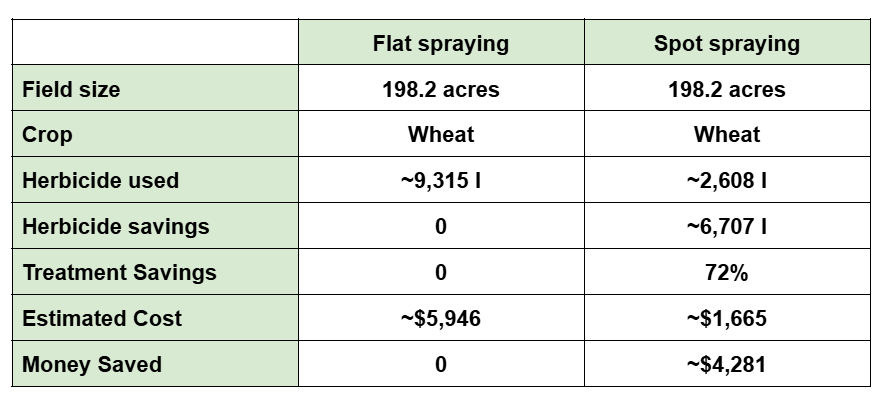
The field covered 198.2 acres, with an estimated herbicide cost of $30 per acre. Based on the AI Weed Detection results, Agremo automatically generated a Prescription Map for spot spraying, dividing the field into two application zones. Areas where broadleaf weeds were detected were assigned a treatment rate of 47 L/ha, while areas without detected weeds were assigned a zero-application rate and were not sprayed.
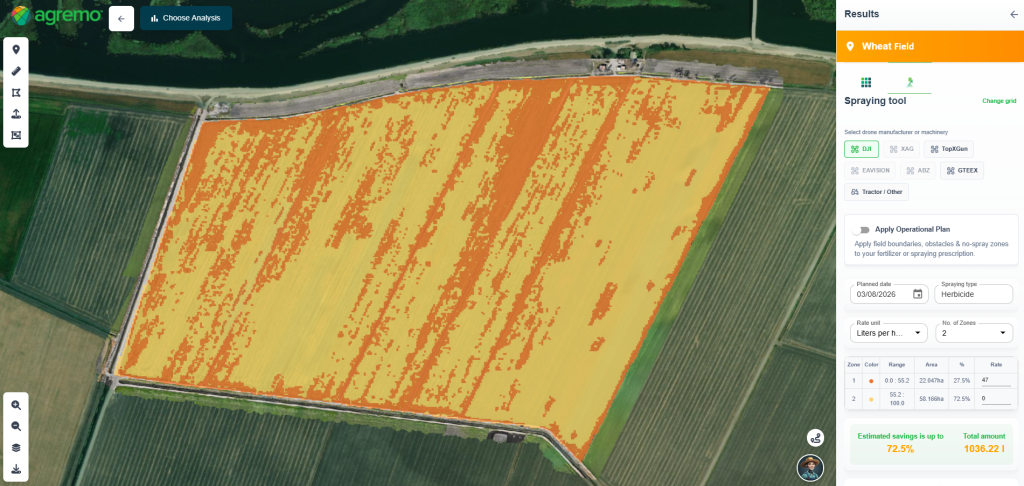
The prescription map was created with a 3 × 3 m tile size and used to guide targeted spraying with a DJI Agras T100. By applying herbicide only to areas with detected weed pressure instead of treating the entire field, the farm achieved a 72% reduction in herbicide costs.
With a standard herbicide cost of $30 per acre, treating all 198.2 acres would have cost approximately $5,946 The targeted application reduced the estimated herbicide cost by approximately $4,281, demonstrating the potential of AI-powered weed detection and precision drone spraying to significantly reduce chemical inputs while targeting the areas that need treatment.
Why AI Weed Detection Matters for Wheat Growers
Weed pressure is rarely distributed evenly across an entire field. Some areas may have dense infestations, while others have little or no detectable weed pressure. Traditional blanket spraying treats both areas the same.
AI weed detection enables growers to see the difference.
By mapping broadleaf weeds, growers can target herbicide application more precisely and reduce unnecessary chemical use. This is especially valuable when weeds survive initial treatment. Large weeds can affect crop performance and interfere with harvest. For wheat growers, the goal is not simply to detect weeds. It is to turn weed detection into a better management decision.
From Weed Detection to Real Savings
“Agremo gave us a much clearer picture of where the weed pressure was in the field. Instead of spraying the entire field, we were able to target the areas that actually needed treatment. The combination of AI weed detection and drone spot spraying helped us significantly reduce our herbicide use and the overall cost of the application.”
— Kevin Palumbo, Owner, Pacific FieldWorks