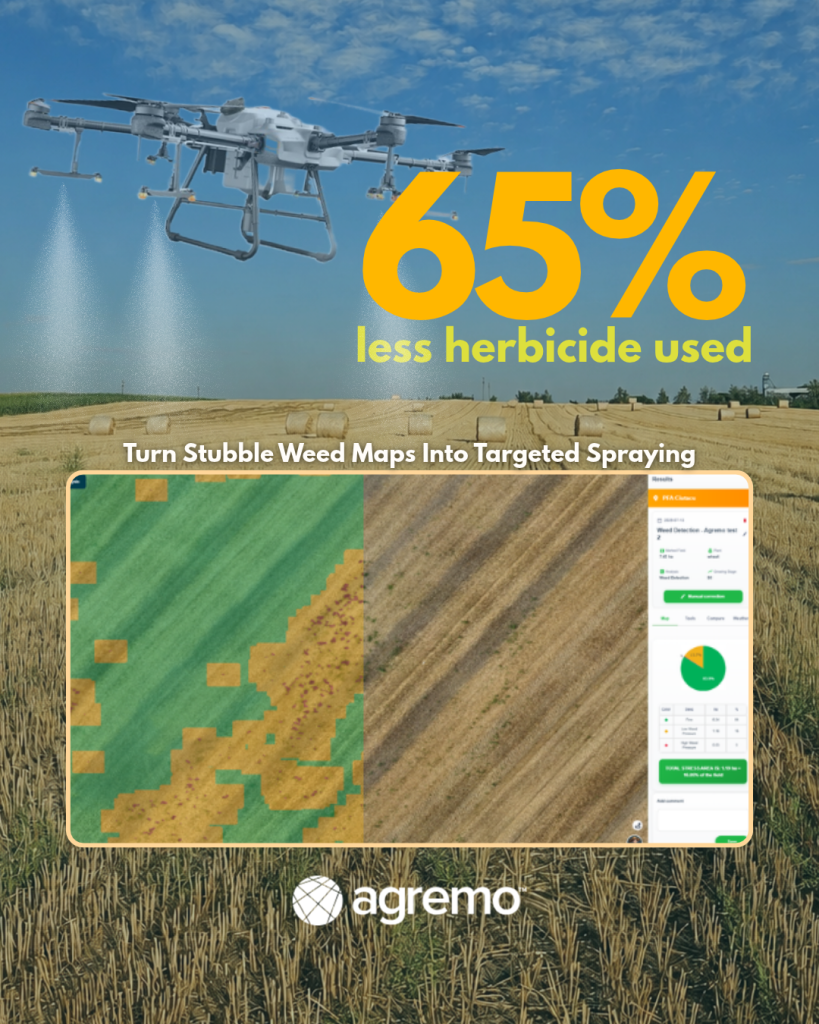
Invasive species represent a global and rapidly increasing threat to agriculture, reducing crop yields, increasing crop protection costs, and putting at risk the long-term profitability of farms and rural communities. These species, whether plant diseases, destructive insects, or aggressive invasive weeds, often lack natural predators in newly introduced environments. As a result, they spread quickly and compete with crops for essential resources such as water, nutrients, sunlight, and growing space.
Without early detection and effective management, invasive species can dominate agricultural land, disrupt ecosystems, and significantly reduce farm productivity.
Massive Economic Losses in Global Agriculture
Globally, invasive species are responsible for hundreds of billions of dollars in economic losses across agriculture, forestry, and fisheries over the past several decades. Research indicates that the total global economic cost of biological invasions exceeded $644 billion between 1970 and 2020, with the agricultural sector among the most heavily affected.
- In the United States, estimated annual losses caused by invasive organisms exceed $137 billion, including reduced crop yields, higher crop protection costs, and additional resources required to control the spread of invasive weeds and plant diseases. Among the most damaging species is Convolvulus arvensis (field bindweed), known for forming dense “carpet-like” infestations across cropland, with reported crop losses exceeding $377 million in a single year due to its presence. A particularly high-demand species for detection is Taeniatherum caput-medusae (medusahead), an aggressive invasive annual grass that creates thick thatch layers, reduces forage quality, suppresses native pasture species, and significantly lowers rangeland productivity.
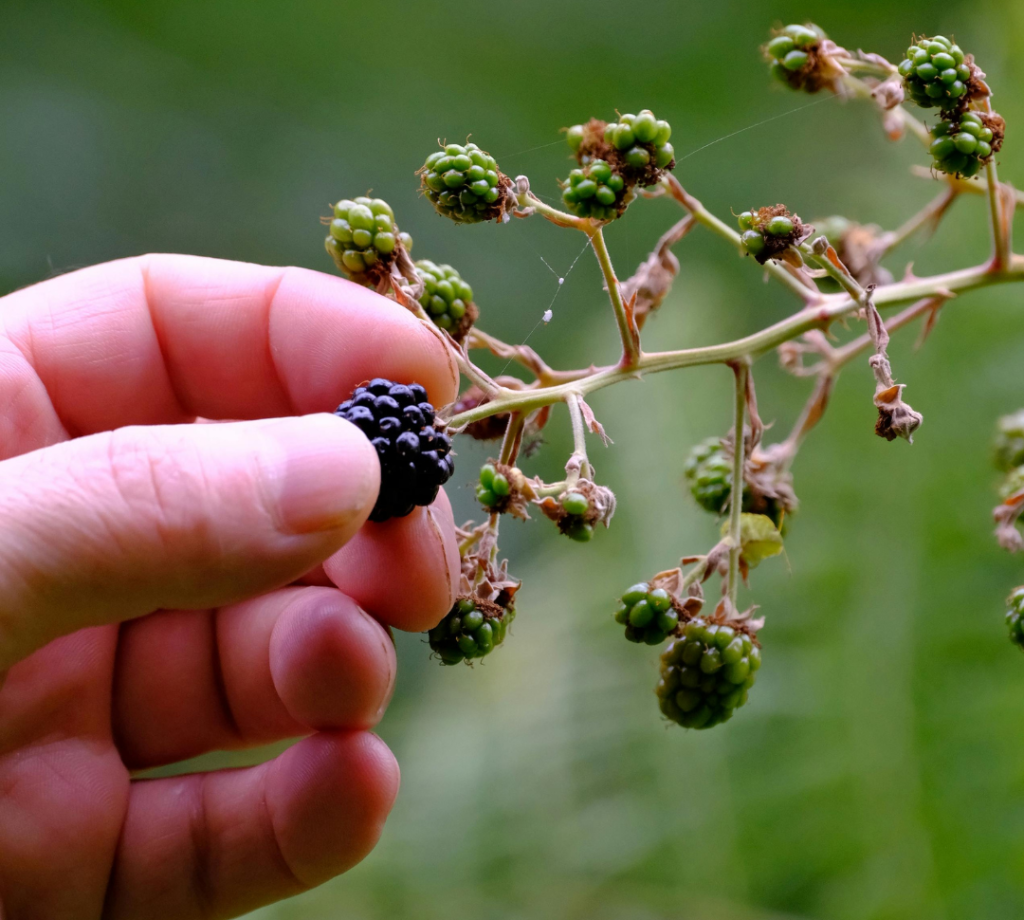
- In Australia, invasive species impose an estimated $25 billion in annual costs on the agricultural sector, contributing to a broader economic impact of approximately $390 billion over the past six decades. These losses stem from reduced pasture productivity, lower crop yields, increased herbicide usage, livestock impacts, and ongoing weed management programs. Among the most damaging invasive weeds affecting Australian farmland is Rubus fruticosus (blackberry), which forms dense, impenetrable thickets that reduce grazing land availability and suppress pasture species. Another high-priority weed is Parthenium hysterophorus (parthenium weed), a toxic invasive plant that contaminates pasture and reduces livestock carrying capacity.
Beyond crop and pasture losses, invasive species increase production costs through intensified chemical applications, increased labor demands, and repeated mechanical interventions, placing ongoing financial pressure on farming operations.
Why Invasive Species Detection Is Critical for Agriculture and Pasture Management
Invasive species detection is no longer optional. It is essential for protecting yields, reducing input costs, and maintaining long-term farm profitability. Modern AI-powered detection systems provide measurable economic and operational benefits across both cropping and pasture systems.
Key Benefits of Invasive Species Detection
🟢 Early Intervention
- Detect infestations before they spread across the entire field
- Reduce long-term control costs
- Prevent yield and pasture productivity losses
🗺 Precise Mapping of Infestation Zones
- Identify the exact location of invasive weeds
- Enable targeted spot spraying instead of blanket applications
- Minimize unnecessary herbicide use
💰 Lower Operational Costs
- Reduce chemical inputs
- Decrease labor and machinery passes
- Improve overall input efficiency
📊 Data-Driven Decision Making
- Support accurate treatment planning
- Integrate with Integrated Pest Management (IPM) strategies
- Reduce financial risk through measurable field data
🌱 Sustainable Pasture Management
- Preserve grazing capacity
- Protect soil health and native vegetation
- Improve long-term land productivity
In regions like Australia, where invasive weeds such as Rubus fruticosus (blackberry), Ulex europaeus (gorse), and Parthenium hysterophorus (parthenium weed) threaten agricultural land, precision invasive species detection technology delivers clear economic value while supporting sustainable grazing systems.
The Solution: Green-on-Green AI Weed Detection + Spot Spraying
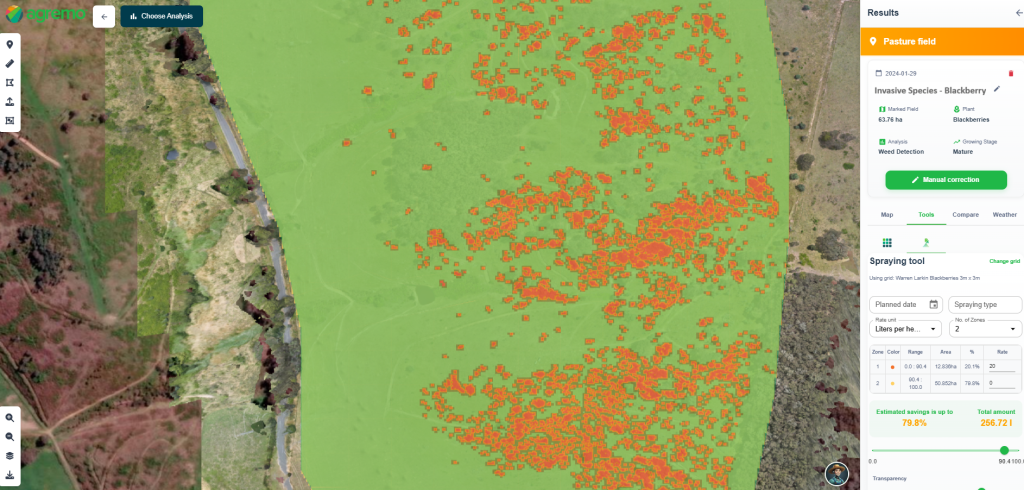
To address localized blackberry infestation in mature pasture, the farmer implemented AI-powered invasive species detection using high-resolution drone imagery.
Field & Analysis Overview
- Location: Australia
- Main Crop: Pasture
- Growing Stage: Mature
- Field Area: 63.7 hectares
- Invasive Species (Weed): Rubus fruticosus (Blackberry)
- Analysis Used: Agremo AI Invasive Species Detection
- Prescription map: Agremo Spraying tool
Detection Results
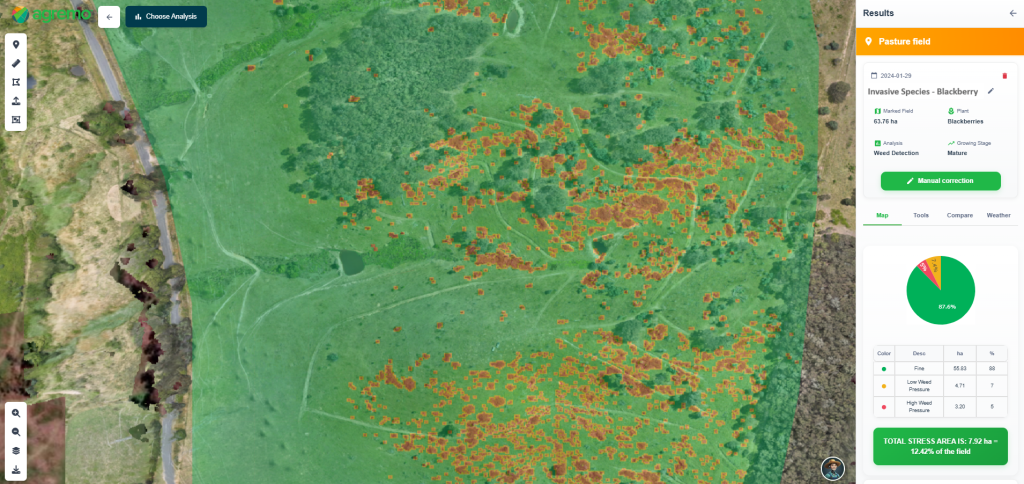
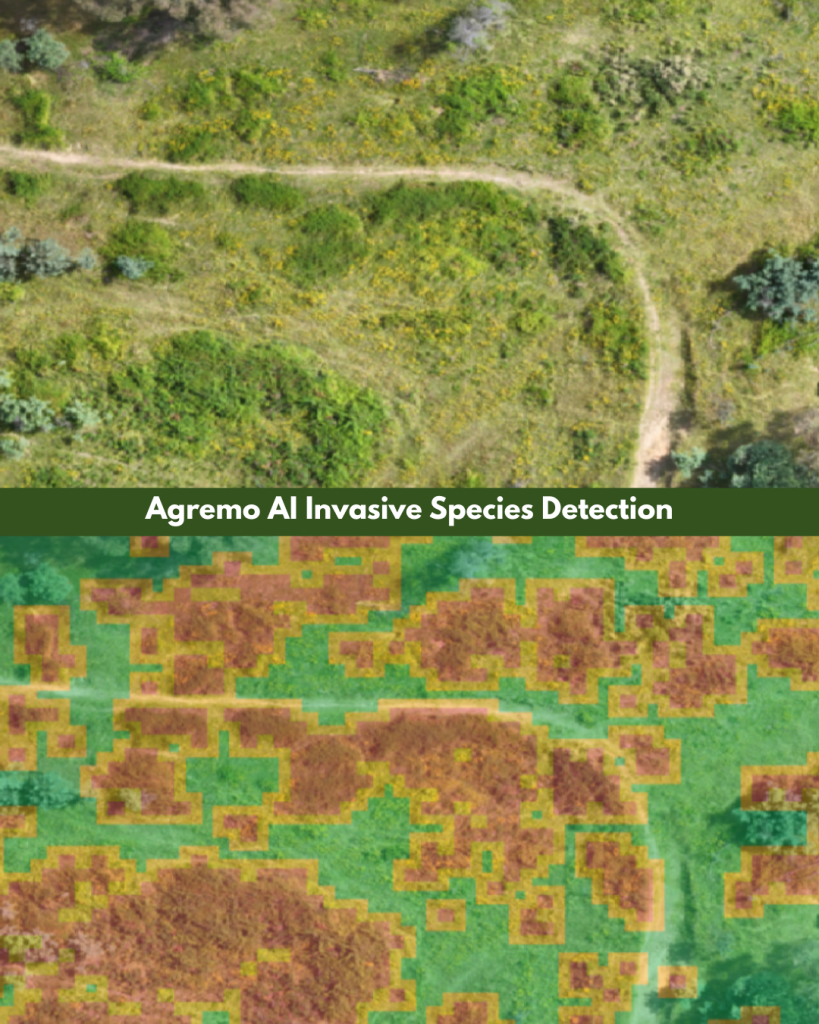
Using advanced Agremo green-on-green AI weed detection, the system accurately identified blackberry plants growing within dense, mature pasture vegetation.
The high-precision weed map revealed:
- Exact infestation zones, clearly delineated from the surrounding healthy pasture, ensuring that the AI algorithm distinguishes invasive weeds from main crops with high accuracy
- Total affected area: 7.92 hectares (12.42% of the 63.7-hectare field)
- 88% of the field remains weed-free
Smart Spot Spraying Strategy
Based on the Agremo AI-generated prescription map:
Spraying was applied in 2 zones: the full herbicide rate was used only in zones where blackberry was detected, while weed-free areas were left untreated
This precision spraying strategy eliminated unnecessary chemical use in weed-free areas, resulting in herbicide savings of up to 79.8% and significantly reducing input costs while maintaining effective invasive weed control.
Customer Testimonial
“Agremo is the best software I have seen so far for green-on-green weed detection.” – Jim Dula
You can watch the full video of this use case, recorded by Jim Dula, at this link.