What Are Field Trials and Why Do They Matter
Field trials are the backbone of modern agriculture. They are used to test, validate, and compare crop performance across different conditions, treatments, and genetics.
They are essential for:
- Seed companies are developing high-yield, resilient varieties
- Agrochemical companies are testing fertilizers, herbicides, and crop protection products
- Research institutions & universities conducting agronomic studies
- Contract research organizations (CROs) managing large-scale trials globally
Field trials are not small experiments. They operate at an industrial scale:
- A single trial can include 50 to 500+ plots
- Large organizations manage thousands of plots per season across multiple locations
- Each plot should be evaluated multiple times during the growing season
- Statistical validity requires replications and multi-location testing
This creates an environment where precision, consistency, and speed are critical and extremely difficult to maintain manually.
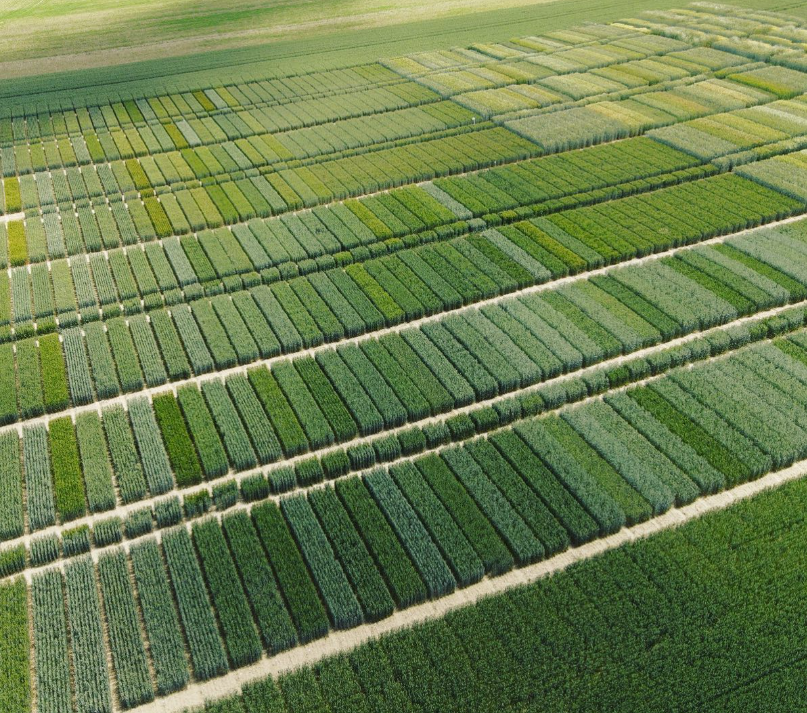
Image source: Staphyt Instagram profile
The Traditional Approach: Subjective, Time-Consuming, and Hard to Scale
Before digital tools and AI, field trials relied almost entirely on manual scoring and visual assessments.
How It Worked
- Agronomists physically walk through fields
- Observations are recorded manually (paper, spreadsheets)
- Scoring is done visually for traits like vigor, weed pressure, lodging
- Measurements are taken plot by plot
The Core Challenges
- Limited scalability
Expanding trials across locations significantly increases labor and cost - Human bias and inconsistency
Visual scoring varies between operators, locations, and time - Time-intensive data collection
Field teams spend hours or days collecting data per trial - No historical visual record
Once data is recorded, the actual field condition is lost - Trade-off between accuracy and efficiency
Larger plots improve reliability but increase operational complexity
Manual field trials are scientifically robust but operationally inefficient.
Case Study: How Staphyt Digitized Field Trials at Scale
From Drone Imaging to Scalable Digital Agronomy
Since 2017, our client Staphyt has been evolving its approach to field trials. Moving from basic drone-based imagery to a fully digital, AI-supported workflow for high-precision plot scoring. What started as simple aerial documentation gradually transformed into a standardized, data-driven system capable of delivering consistent results across multiple locations and seasons.
Building a Scalable System
Rather than adopting new technology overnight, Staphyt developed its capabilities step by step:
- Early efforts focused on testing and validating drone-based scoring accuracy, supported by expanding their fleet with solutions like M2air drones
- The introduction of the DJI Mavic 3 Multispectral (M3M) marked a shift toward multispectral analysis, enabling more advanced crop assessment and internal scoring programs
- As confidence in the methodology grew, Staphyt established validation protocols across 15 locations, ensuring that drone-derived data meets research-grade standards
This structured approach allowed them to transition from experimentation to fully operational, commercial-scale field trials monitoring.
Scaling Across Europe
Today, Staphyt operates at a scale that would be difficult to achieve with traditional methods:
- 25,000+ plots scored annually
- Trials conducted across multiple countries, from Romania to Spain
- 20 licensed drone technicians performing complex scoring workflows
- 10+ drones deployed, enabling rapid mission execution
- 50+ internal and commercial flight missions per season
A single drone flight takes approximately 10 minutes per field, allowing entire trials to be captured under uniform conditions, which is critical for reliable comparison and analysis.
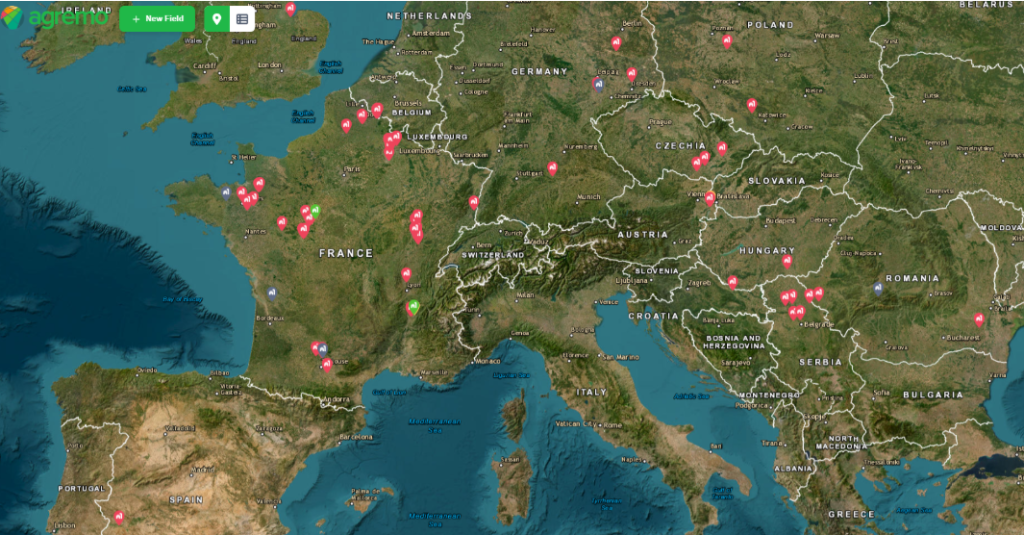
Staphyt Field Trial Locations Managed in Agremo
The Agremo Solution for Scalable, Data-Driven Field Trials
By leveraging Agremo, organizations like Staphyt transform raw drone imagery into high-quality, research-grade insights at scale, combining advanced AI with agronomic expertise to ensure both precision and reliability.
Core AI Analyses Validated by Agronomic Expertise
- Stand Count – A unique in-field solution delivering plot-level stand analysis, including total plant count, plants per row, plant density, seeding targets, and deviation (%), enabling precise emergence evaluation.
- Plant Vigor – Advanced vegetation health assessment, delivering highly detailed insights into crop vigor, biomass strength, and spatial variability within each plot for more accurate crop performance analysis.
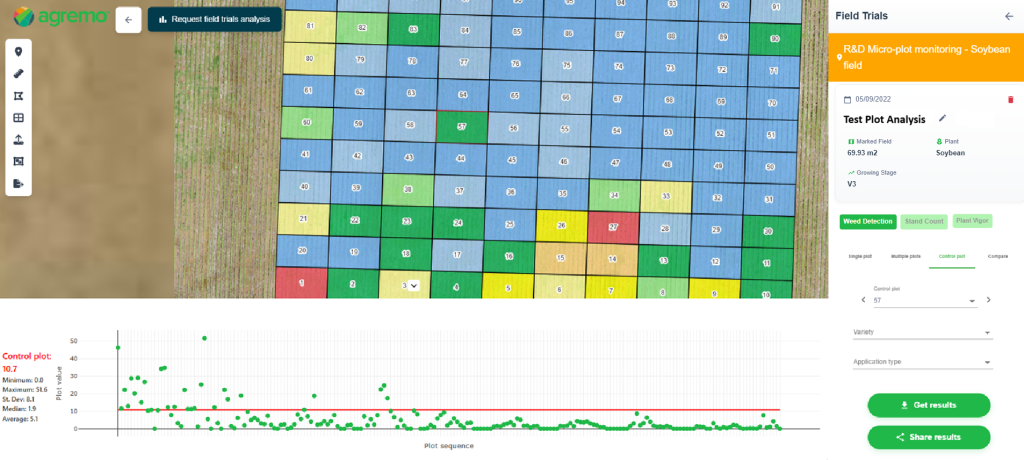
- Weed detection – An industry-leading solution that quantifies weed pressure per plot (percentage and area) and detects weeds in challenging green-on-green conditions for reliable crop-to-weed separation.
- Canopy Cover – High-precision analysis of crop coverage per plot (percentage and area), enabling insights into establishment, uniformity, and coverage efficiency.
- Lodging – Automated analysis measuring lodged crop per plot (percentage and area), enabling fast and objective assessment of damage caused by wind, rain, or structural weakness.
- Plant Height – Plot-level plant height measurement delivering statistical insights, including average, maximum, and minimum heights, standard deviation, and mean values, enabling detailed crop growth comparisons across trials.
- Stay green – Vegetation maturity analysis that identifies and quantifies the percentage and area of green (non-mature) crop within each plot, commonly used pre-harvest to evaluate ripening speed and uniformity across treatments.
Vegetation indices such as NDVI complement AI analyses by adding a layer of crop health context.
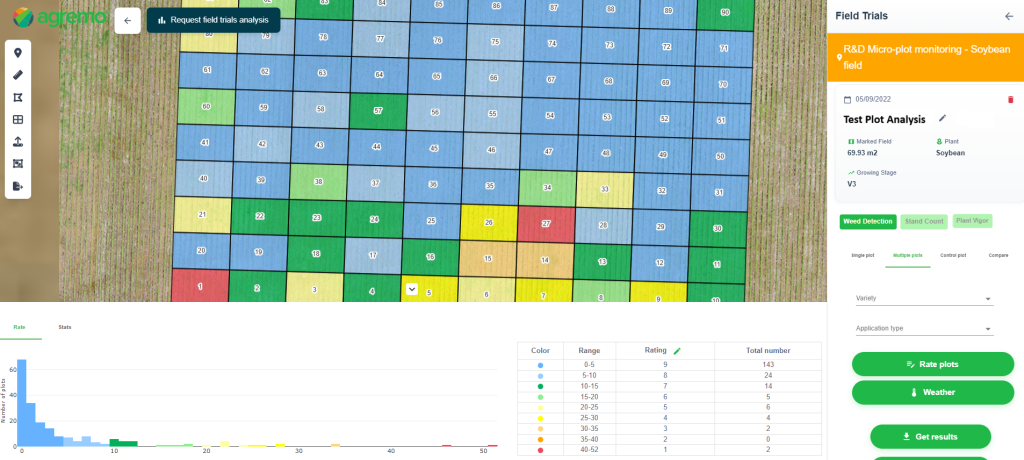
Core Agremo Features Used
- Stitching – Advanced image stitching technology that combines multiple drone images into a seamless, high-resolution field map, enabling accurate plot-level analysis across large trial areas.
- Plot Scoring – Standardized plot evaluation system that enables objective assessment of crop performance across multiple traits, ensuring consistent and repeatable scoring across field trials.
- Control Plot Comparison – Built-in comparison feature that allows direct benchmarking of trial plots against designated control plots, helping identify treatment impact and performance differences with high clarity.
- Compare Tool – An interactive analysis tool for side-by-side or swipe comparison of plots across key agronomic traits and over time, enabling faster interpretation and data-driven decisions.
- Comprehensive CSV Export – Detailed export functionality that consolidates all AI-derived and vegetation index-based analyses into a single structured CSV file, enabling advanced offline analysis and integration into research workflows.
What Staphyt Achieved
By transforming their workflow, Staphyt moved from manual, experience-driven assessments to a scalable, standardized, and data-driven field trial operation.
This shift enabled:
- Massive scalability without compromising quality
From individual trials to 25,000+ plots annually, across multiple countries and environments - Consistent and objective data collection
Standardized drone flights and protocols eliminated operator variability and improved comparability across locations - Higher data reliability
Drone-based insights, combined with agronomic validation, ensured that results are both quantitative and trustworthy - Faster and more efficient workflows
A significant portion of fieldwork was shifted to the office, dramatically reducing time spent on manual data collection while increasing throughput - Elimination of subjectivity in scoring
Transitioning from visual assessments to AI-supported analysis enabled more consistent, repeatable results across trials - Full historical traceability
The platform captures every trial as visual data, allowing teams to revisit conditions, validate results, and gain deeper insights over time.
Ultimately, Staphyt didn’t just optimize their field trials. They redefined how trials are executed, analyzed, and scaled.
Scalable, data-driven insights that enable better decisions, delivered faster with confidence.
“Drones freeze the moment, allowing us at the report stage to look back and understand the reasons behind specific results.”
— Ludovic Pachet, Seeds Technical Manager, Staphyt